Clocks Fall Back This Weekend as Permanent Daylight Saving Time Debate Shows Winter Sunrises After 9 AM in Marquette, Fargo and Boise
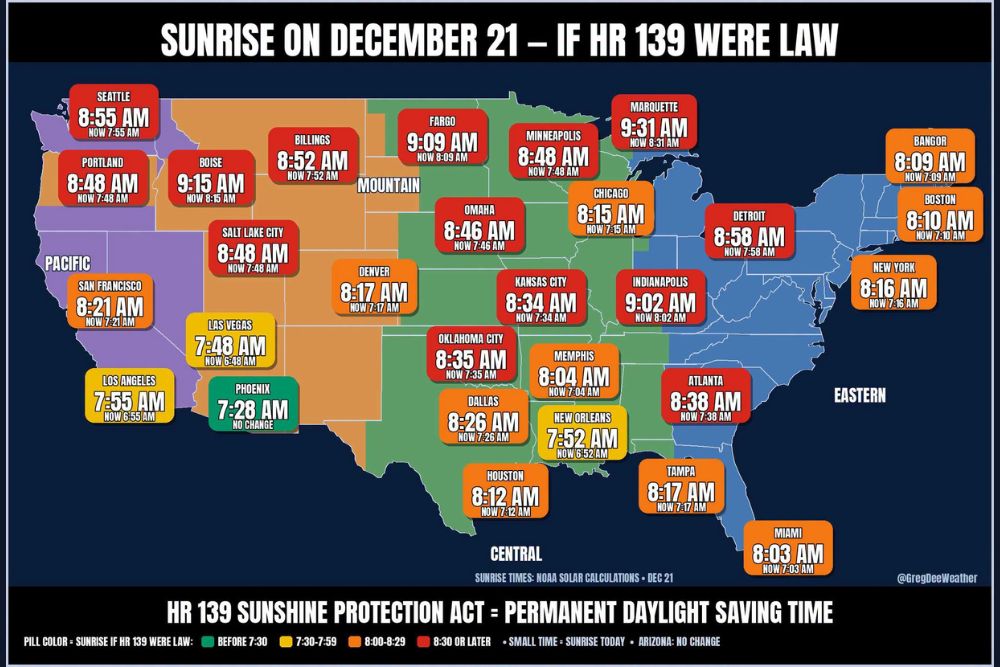
WASHINGTON, D.C. — Americans will fall back into Standard Time this weekend, setting clocks back one hour on Saturday night into Sunday morning, November 1. The annual time change comes as debate continues over whether the country should switch to permanent Daylight Saving Time under a proposal known as HR 139, the Sunshine Protection Act. The measure has not become law, and a new map highlights what winter mornings could look like if it did, with some cities not seeing the sunrise until after 9 AM around the shortest day of the year.
What Permanent Daylight Saving Time Would Mean
Under permanent Daylight Saving Time, clocks would no longer fall back each November. Instead, the extra hour of evening daylight enjoyed during summer would remain in place year-round.
Supporters argue this would maximize evening daylight, giving people more time for outdoor activities, shopping, and recreation after work and school. Opponents point out that the change would push winter sunrises much later, leaving many students heading to school in total darkness.
Latest Sunrises Across the Northern Tier
The map shows projected sunrise times on December 21, the first day of winter, if HR 139 were law. Some of the latest sunrises would occur across northern and western parts of the Central and Mountain time zones.
Marquette, Michigan, would see the sun rise at about 9:31 AM, compared with 8:31 AM under current rules. Boise, Idaho, would see sunrise near 9:15 AM, while Fargo, North Dakota, would wait until about 9:09 AM. Indianapolis would see sunrise around 9:02 AM, and Detroit near 8:58 AM.
Major Cities Would See Sunrises After 8 AM
Many large cities would also experience much later mornings. Seattle would see sunrise near 8:55 AM, Billings around 8:52 AM, and Portland, Salt Lake City, and Minneapolis near 8:48 AM. Omaha would reach sunrise around 8:46 AM, while Atlanta would wait until about 8:38 AM.
Oklahoma City, Kansas City, Dallas, San Francisco, Denver, Tampa, New York, Chicago, and Boston would all see sunrise between roughly 8:10 and 8:35 AM.
Earlier Sunrises in the South and Southwest
Southern cities would see somewhat earlier sunrises. New Orleans would see the sun rise around 7:52 AM, Los Angeles near 7:55 AM, and Las Vegas around 7:48 AM. Memphis would reach sunrise near 8:04 AM, while Miami would see sunrise around 8:03 AM.
Phoenix would see no change at 7:28 AM, since most of Arizona does not observe Daylight Saving Time.
Arguments on Both Sides
Those in favor of permanent Daylight Saving Time say longer evenings could support outdoor recreation and local businesses and would end the twice-yearly clock change. Those opposed raise concerns about dark winter mornings, student safety at bus stops, and the effects of later sunrises on daily routines.
Remember to Change Your Clocks
For now, residents should remember to set clocks back one hour before going to bed on Saturday night. It is also a good time to check smoke detector and carbon monoxide detector batteries.
For continuing coverage of seasonal changes, sunrise times, and critical weather analysis across the United States, visit Weather Radar.