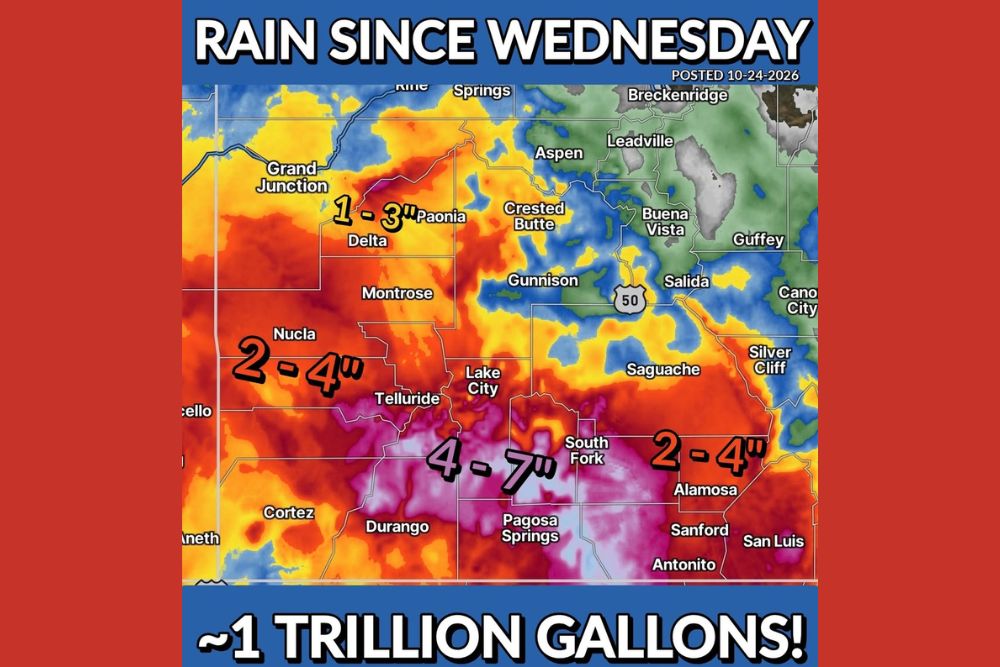
Historic Rain Dumps 4 to 7 Inches on Southwest Colorado in 72 Hours as Alamosa Logs Wettest October and Pagosa Springs River Nears Record
PAGOSA SPRINGS, CO — Southwest Colorado was hit by a truly historic rainfall event this week, with some areas picking up 4 to 7 inches of rain in just 72 hours. The storm, which began on Wednesday, delivered record-setting totals across the San Juan Mountains and the San Luis Valley, pushing rivers to near-record levels. Alamosa recorded its wettest October on record, while the San Juan River at Pagosa Springs reached its second-highest crest ever recorded, making this one of the most remarkable late-October storms in the state’s history.
Heaviest Rain Across the San Juan Mountains
The highest totals, ranging from 4 to 7 inches, were concentrated across the San Juan Mountains, including areas near Lake City, South Fork, Telluride, and Pagosa Springs. Rainfall estimates from MRMS data show a large area of deep purple and magenta shading stretching across this region, indicating the most extreme totals.
Surrounding areas, including Durango, Cortez, and parts of the Rio Grande headwaters, also saw significant rainfall. The intense precipitation fell over steep mountain terrain, rapidly feeding creeks and rivers throughout the region.
Alamosa Sets an October Record
In the San Luis Valley, Alamosa recorded its wettest October on record. On Thursday, the city picked up 1.67 inches of rain, making it the second wettest day ever recorded in Alamosa, just short of the all-time daily record of 1.77 inches.
Totals of 2 to 4 inches were reported across the broader valley, including areas near Sanford, Antonito, and San Luis, which is extraordinary for a region that typically receives very little precipitation.
San Juan River Reaches Near-Record Crest
The San Juan River at Pagosa Springs rose to its second-highest recorded crest, flooding low-lying areas near the river and prompting concern for downstream communities. The same river system has also caused historic flooding farther downstream in Farmington, New Mexico, where water levels broke a record that had stood since 1909.
Western Slope Also Soaked
Areas across the Western Slope also received heavy rainfall. Nucla and surrounding communities picked up around 2 to 4 inches, while Delta, Paonia, and areas near Grand Junction received roughly 1 to 3 inches. Montrose, Crested Butte, and Gunnison also saw notable rainfall during the event.
Off the Charts Compared to Normal
Some locations received more than 1,700 percent of their normal weekly precipitation, or about 17 times the typical amount for this time of year. An estimated 1 trillion gallons of rain fell across southwest Colorado in just three days, based on a rough calculation of rainfall totals across the region.
Ongoing Flood Concerns
Residents near rivers, creeks, and burn scars should stay alert as water continues to drain from the mountains. Drivers should never attempt to cross flooded roads, and travelers should check road conditions before heading through mountain passes.
For continuing coverage of Colorado flooding, river levels, and critical weather analysis across the United States, visit Weather Radar.