Orionid Meteor Shower Peaks With Clear Skies Over Texas, Illinois, Georgia and Florida While Clouds Block Views in California, Arizona and Utah
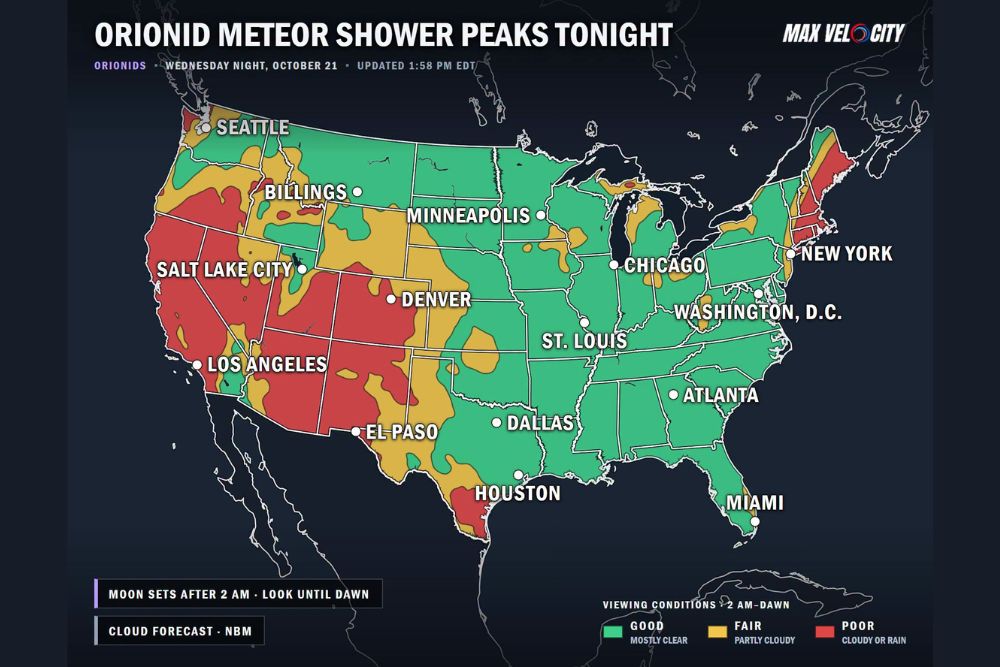
CHICAGO, IL — The Orionid meteor shower reached its peak overnight from Wednesday, October 21, into early Thursday, October 22, giving skywatchers across much of the central and eastern United States a chance to see tiny fragments of Halley’s Comet streaking through the sky. The best viewing window ran from moonset, around 3 or 4 AM, until dawn, when darker skies allowed fainter meteors to stand out. A cloud forecast showed mostly clear skies across a large part of the country, while the West and Northeast faced cloudier conditions.
Pieces of Halley’s Comet Light Up the Sky
The Orionids occur each October when Earth passes through a trail of dust and debris left behind by Halley’s Comet. As these tiny particles enter the atmosphere at high speeds, they burn up and create bright streaks of light known as meteors.
The shower gets its name from the constellation Orion, where the meteors appear to originate. Orionid meteors are known for their speed and can sometimes leave glowing trails that linger for a few seconds after the meteor fades.
Best Viewing Window After Moonset
With the moon setting after 2 AM, the darkest skies arrived in the early morning hours. Viewing conditions were rated from 2 AM until dawn, giving early risers and night owls the best opportunity to spot meteors without moonlight washing out the sky.
Skywatchers were encouraged to find dark locations away from city lights, allow their eyes about 20 to 30 minutes to adjust, and look broadly across the sky rather than focusing on a single point.
Good Viewing Across the Central and Eastern U.S.
The cloud forecast showed good, mostly clear conditions across a wide portion of the country. This included Texas, Oklahoma, Kansas, Missouri, Illinois, Indiana, Ohio, Tennessee, Georgia, Alabama, the Carolinas, and Florida. Cities such as Dallas, Houston, St. Louis, Chicago, Atlanta, Washington, D.C., and Miami were all within the favorable viewing zone.
Clear skies also extended across the Upper Midwest, including Minneapolis, as well as much of the Dakotas and Montana.
Fair Conditions Across the Plains and Rockies
Partly cloudy skies brought fair viewing conditions to parts of Colorado, Wyoming, Montana, western Kansas, and portions of New Mexico and West Texas. Areas near Billings and Denver sat close to this zone, where breaks in the clouds may have allowed some meteors to be seen.
Fair conditions were also noted in parts of Michigan, Wisconsin, and along sections of the New Jersey coast.
Clouds Spoil Views in the West and Northeast
Poor viewing conditions due to clouds or rain affected much of the Southwest and West Coast, including California, Nevada, Arizona, Utah, and western Colorado. Cities such as Los Angeles, Salt Lake City, and El Paso were in the cloudiest zones, along with areas near Seattle.
Cloudy skies also covered much of New England, including parts of Maine, Massachusetts, and Connecticut, as well as the area near New York. A pocket of poor conditions also extended into South Texas near the Rio Grande.
More Chances in the Coming Nights
The Orionids remain active for several days around their peak, so skywatchers who missed the early morning show may still catch a few meteors in the nights ahead under clear, dark skies.
For continuing coverage of meteor showers, sky events, and critical weather analysis across the United States, visit Weather Radar.